Artificial Intelligence In Panoramic Radiography Interpretation: A Glimpse Into The State-Of-The-Art Radiologic Examination Method
Abstract
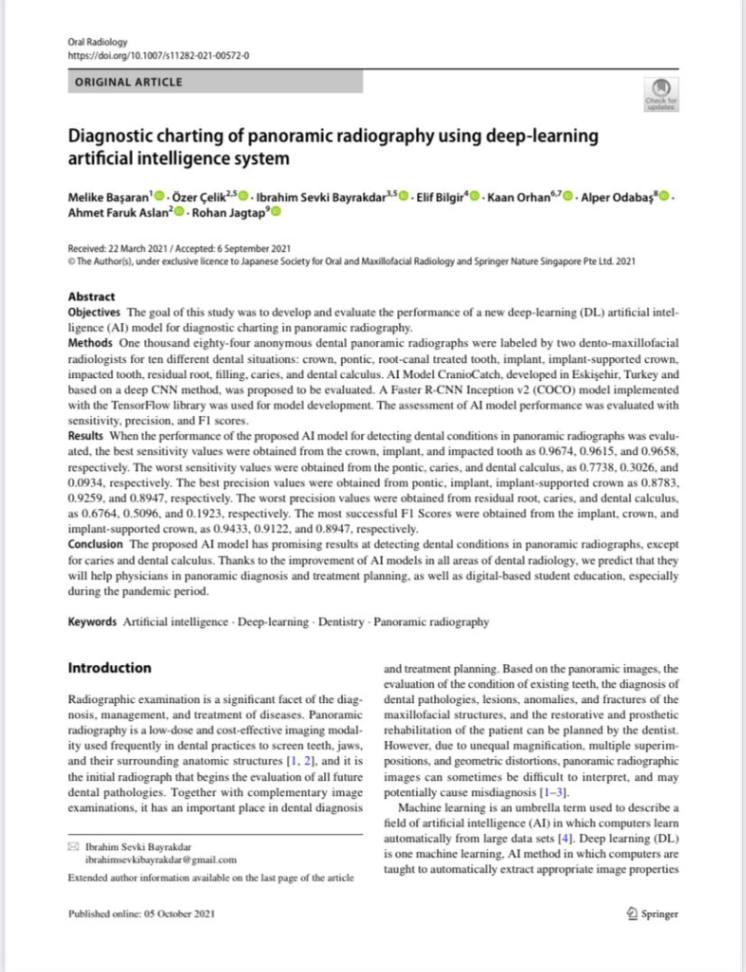
Aim: Panoramic radiography is a frequently utilized imaging technique in standard dental examinations and provides many advantages. In this context, studies have been conducted to develop tools to assist physicians in clinical practice by using deep learning models to interpret panoramic radiography images. However, studies in the existing literature have generally addressed these conditions separately, and studies that develop a multiclass diagnostic charting model that can detect and segment all these conditions are very limited. Therefore, the aim of the present study was to develop a deep learning model that can accurately evaluate and segment various dental issues and anatomical structures in panoramic radiographs obtained from different radiography devices and settings.Materials and methods: Panoramic radiographs were labeled for 33 different conditions in the categories of dental problems, dental restorations, dental implants, anatomical landmarks, periodontal conditions, jaw pathologies, and periapical lesions. A YOLOv8 model was employed to develop an artificial intelligence model for each labeling. A confusion matrix was utilized to successfully evaluate the developed models.
Results: The algorithm achieved a precision value of 0.99 to 1.00 in accurately detecting various dental features, such as adult tooth numbering, filling, dental implants, dental pulp, root canal filling, mandibular canal, mandibular condyle, mandible, and pharyngeal airway. With respect to sensitivity, the adult tooth numbering, dental implants, mandibular canal, maxillary sinus, mandibular condyle, angle of the mandible, nasal septum, mandible, and hard palate showed the highest values of 0.99 to 1.00. The F1 score reached the highest value of 0.99 to 1.00 for the root canal filling, adult tooth numbering, dental implants, mandibular canal, mandibular condyle, angle of the mandible, mandible, and pharyngeal airway.
Conclusion: Artificial intelligence based on convolutional neural networks has a remarkable ability to detect different conditions observed in regular clinical evaluations in panoramic radiographs, displaying excellent performance. Based on these findings, it can be confidently stated that deep learning-based models have great potential to improve routine clinical practices for physicians. (Int J Comput Dent 2025;28(4):309-0; doi: 10.3290/j.ijcd.b6173229).
I Want to Write a Scientific Research Project
CranioCatch is a global leader in dental medical technology that improves oral care in the field of dentistry. With AI-supported clinical, educational, and labeling solutions, we provide significant improvements in the diagnosis and treatment of dental diseases using contemporary approaches in advanced machine learning technology.
CranioCatch serves thousands of patients with dental health issues worldwide every day with its innovative technologies. That’s why we eagerly look forward to meeting our valued dentists who wish to work in the field of 'Scientific Research in Dentistry'.
 Contact Us